

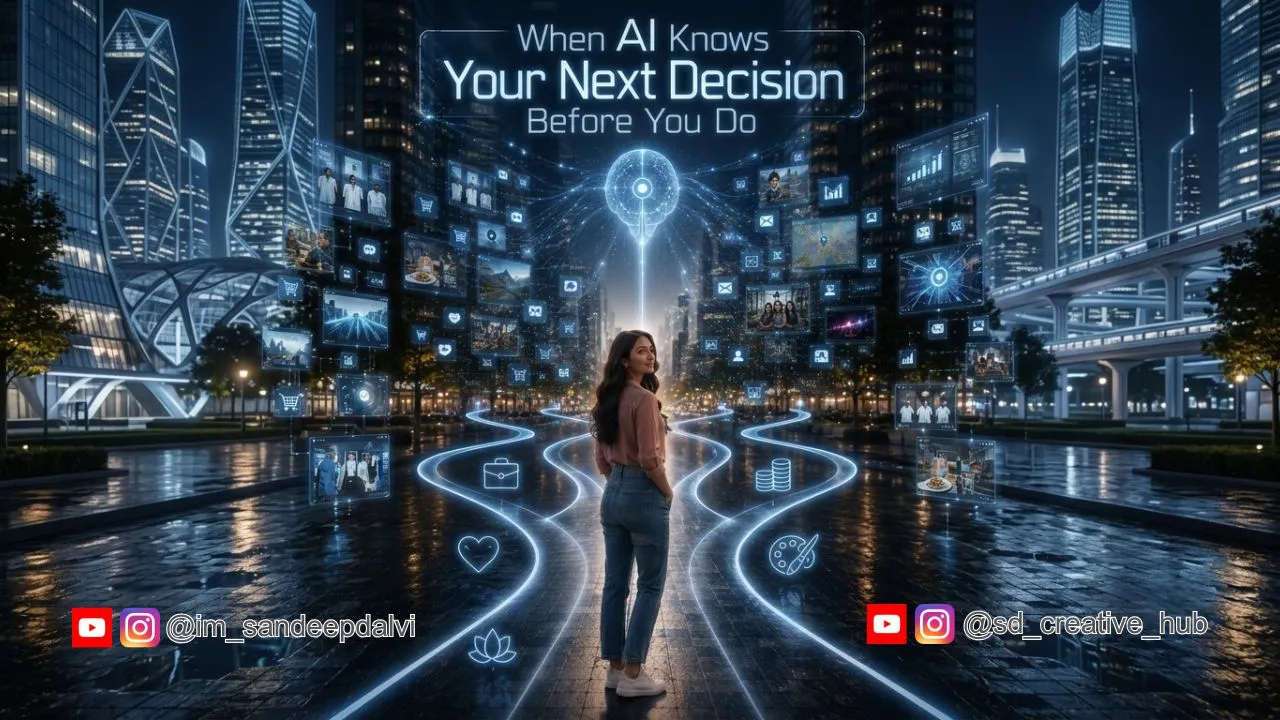
What if your next decision isn't really your own? Every search, click, purchase, and pause leaves behind a pattern. The real question isn't whether AI can predict us — it's whether those predictions begin shaping the decisions we believe are our own.
AI systems today can predict human decisions with remarkable accuracy by analyzing behavioural data — your searches, purchases, pauses, and patterns. More unsettling than the prediction itself is what happens next: when AI-generated suggestions, recommendations, and nudges begin shaping the very choices we believe we are making freely. The line between prediction and influence is far thinner than most people realize.
- Introduction
- How AI Learns to Predict You
- The Data Trail You Leave Behind
- From Prediction to Influence: The Critical Shift
- Where This Is Already Happening
- The Question of Autonomy
- The Feedback Loop Problem
- Ethical Boundaries and Who Draws Them
- Experience & Insight: What This Means for How We Think
- Frequently Asked Questions
- Key Takeaways
- Conclusion
Introduction
There is a quiet revolution happening inside the devices you use every day — and most people have no idea it is underway. It does not announce itself with dramatic headlines or technical jargon. It operates in the background, behind the interface, beneath the recommendation, inside the tiny nudge that makes one choice feel slightly more natural than another. It is the growing ability of artificial intelligence to know what you are going to do before you have consciously decided to do it.
This is not science fiction. It is not a distant warning from a dystopian novel. It is the product of decades of accumulated behavioural data, increasingly sophisticated machine learning models, and an economic ecosystem that has discovered enormous value in anticipating human desire. Every search query you type, every product you hover over and do not buy, every article you abandon halfway through, every route you take to work — each of these leaves a trace. And those traces, stitched together at scale, create something remarkable: a predictive portrait of who you are and, more importantly, what you will want next.
But the more provocative question is not whether AI can predict us. It is what happens after the prediction. When an algorithm that knows your next move also controls what you see, what options you are offered, and how those options are presented — the prediction stops being a mirror. It becomes a mould. And that distinction matters enormously for how we think about choice, freedom, and what it means to make a decision that is genuinely our own.
How AI Learns to Predict You
Predictive AI does not understand you the way a friend does. It does not grasp your values, your fears, your history, or your dreams. What it does understand — with extraordinary precision — is your behaviour. And behaviour, it turns out, is remarkably consistent and remarkably revealing.
Modern predictive models are trained on what data scientists call behavioural signals: the digital footprints of actions taken across time. These include not just the obvious — what you buy, what you search for, what you watch — but also the subtle. How long you pause on a piece of content before scrolling. What time of day you make impulsive purchases. How your typing speed changes when you are anxious. Whether you read reviews before buying or add items to a cart at 2 a.m. without reflection.
The models that learn from these signals are not primarily trying to understand your reasoning. They are trying to find patterns across millions of people who behaved the way you are behaving right now — and then use the outcomes of those people's behaviour to predict yours. It is pattern recognition at civilizational scale, and it is remarkably effective. Studies have shown that AI models can predict personality traits, political beliefs, and purchasing decisions with accuracy rates that comfortably outperform human intuition.
The three engines of prediction
The predictive ecosystem runs on three interlinked engines. The first is data aggregation — the collection and consolidation of behavioural signals from every digital touchpoint. The second is collaborative filtering — finding people who resemble you and using their subsequent choices to anticipate yours. The third is reinforcement learning — systems that continuously refine their predictions based on whether their suggestions led to the anticipated outcome, creating models that improve with every interaction.
Together, these engines power a prediction apparatus that operates in real time, at personalized scale, across billions of users simultaneously. The sheer computational ambition of it is staggering — and the practical effect on individual experience is profound.
The Data Trail You Leave Behind
Most people dramatically underestimate how much data they generate and how richly that data describes them. The average smartphone user generates gigabytes of behavioural data every month — most of it without conscious awareness that any recording is happening at all.
Consider a single evening. You check social media, pausing longer on posts about travel than posts about politics. You search for flights to a city you have never been to, then close the browser without booking. You watch three episodes of a series before switching to something lighter. You order food delivery at 9 p.m. rather than cooking, as you have done every Thursday for the past six weeks. You send a voice message to a friend that is slightly shorter and more clipped than usual. You fall asleep with your phone still lit.
Each of these micro-behaviours is a data point. Taken individually, none of them means very much. Taken together, across weeks and months, they tell a story of considerable specificity — your stress levels, your social patterns, your financial situation, your emotional state, your aspirations, and your vulnerabilities. And that story is being read, continuously, by systems optimized to extract value from it.
From Prediction to Influence: The Critical Shift
Prediction alone would be impressive but relatively benign — a technological curiosity. The transformation into something more significant happens at the moment prediction is coupled with presentation. When an AI predicts that you are likely to want something and then presents that thing to you first, more prominently, more attractively framed than alternatives, the prediction stops being passive. It becomes active. It shapes the environment in which you will make your choice.
This is the domain of what behavioral economists call choice architecture — the design of the context in which decisions are made. And AI is now the world's most powerful architect of choice. Every time you open a streaming platform and find a show already queued and waiting, every time a search engine completes your query in a direction you had not consciously formulated, every time an e-commerce site presents a product at exactly the price point and aesthetic that matches your previous behaviour — the algorithm is not just predicting your desire. It is constructing the environment in which that desire feels inevitable.
The philosophical implications are significant. A choice made in an environment curated by an algorithm that predicted you would make it — is that still a free choice? The hand you reach out was your own. But the landscape your hand moved through was arranged by something that knew, in advance, where it would reach.
Where This Is Already Happening
It would be a mistake to treat predictive AI as a future concern. It is already embedded, at significant depth, across the industries that shape daily life.
Retail and e-commerce
Amazon's recommendation engine is perhaps the most studied example of predictive commerce — responsible, by various estimates, for a substantial portion of the company's revenue. It does not merely suggest products you might like. It surfaces them at the precise moment in the purchase journey when you are statistically most likely to convert, based on aggregate patterns across millions of similar customers. The result is a shopping experience that feels intuitive because it has been engineered to anticipate you.
Social media and content platforms
The recommendation algorithms of platforms like YouTube, TikTok, and Instagram are optimized for engagement — and engagement, it turns out, is predictable. These systems learn which categories of content hold your attention, what emotional register keeps you scrolling, and what type of content you are statistically likely to interact with even if you would not have sought it out deliberately. Over time, the content environment shifts around you, shaped by a model of your attention that you never consciously provided.
Finance and credit
Financial institutions increasingly use behavioral AI to assess creditworthiness, predict loan default risk, and personalize product offerings. Some systems analyse patterns in application behavior — how long someone takes to fill out a form, what fields they revisit — as supplementary signals. The financial products you are offered, and on what terms, may increasingly reflect a prediction about your future behaviour that you had no part in forming.
Healthcare
Predictive models in healthcare are being used to identify patients at elevated risk of conditions before symptoms appear — a potentially life-saving application. But the same infrastructure, in different hands, can predict when a patient is likely to disengage from treatment, what interventions are most likely to achieve compliance, and how to frame health decisions to maximize the probability of a particular outcome. The benevolent and the paternalistic sit uncomfortably close together.
The Question of Autonomy
At the heart of this discussion is a philosophical question that predates AI by centuries: what does it mean to make a free choice? Philosophers from Kant to contemporary behavioral economists have grappled with the tension between the appearance of freedom and the structural conditions that shape it. AI does not invent this tension. But it intensifies it to an unprecedented degree.
Human decision-making has always been influenced by environment — by social pressure, by advertising, by the way options are arranged on a supermarket shelf. None of us makes choices in a vacuum, and cognitive science has long established that our preferences are deeply susceptible to framing, context, and presentation. What AI changes is the personalization and precision of that influence.
When a billboard presents the same advertisement to everyone who drives past it, the influence is broad but crude. When an AI model presents a personalized nudge to a specific individual at a specific moment, calibrated to their psychological profile and informed by their behavioural history, the influence is targeted and refined in ways that raise genuine questions about whether the resulting choice reflects the person's authentic preferences or the algorithm's prediction of what will make them act.
The Feedback Loop Problem
Perhaps the most structurally concerning aspect of predictive AI is what happens when prediction and influence operate together over time: a feedback loop forms that can progressively narrow the range of choices a person encounters, and therefore the range of choices they consider.
If an algorithm predicts that you prefer a certain type of content and shows you more of it, and you engage with that content (as predicted), and the algorithm takes that engagement as confirmation and shows you even more — your informational environment begins to contract around a model of yourself derived from your past behaviour. You do not just receive content you are likely to like. You receive a version of reality filtered through what an algorithm has decided you already are.
This is the filter bubble problem — well documented in the context of political information, but equally present in commercial, social, and cultural contexts. Over time, the feedback loop does not just predict who you are. It participates in defining who you become, by shaping which ideas, products, people, and possibilities you encounter at all. The self that the algorithm learns from and the self that the algorithm helps create are not separate entities. They are in continuous, mutual construction.
Ethical Boundaries and Who Draws Them
The ethical landscape around predictive AI is contested, evolving, and deeply consequential. The core tension is between two legitimate interests: the value that personalization and prediction deliver to users (convenience, relevance, efficiency) and the risk that those same mechanisms undermine meaningful autonomy and create systems of manipulation that operate below the threshold of conscious awareness.
Regulatory frameworks are beginning to catch up. The European Union's General Data Protection Regulation (GDPR) introduced rights around automated decision-making and profiling. The proposed AI Act seeks to categorize and govern AI systems by risk level. Some jurisdictions have introduced restrictions on behavioural targeting directed at children or on the use of sensitive categories of data for prediction.
But regulation moves slowly, and the technology moves fast. The most important ethical work may not be legislative — it may be cultural. It requires developing widespread literacy about how predictive systems work, what they optimize for, and whose interests they serve. It requires that individuals have meaningful transparency about when they are being predicted and influenced, and genuine tools to modulate that influence rather than merely acknowledge it.
The most important shift that predictive AI demands of us is not technical — it is epistemic. It asks us to become aware of the conditions under which we form preferences, in a way that most people have never needed to be. When a choice feels natural, obvious, or inevitable, it is worth pausing to ask: was this desire already mine, or was it placed in my path by something that predicted I would pick it up?
That question is not easy to answer. We cannot step outside our own minds to audit our preferences against some uninfluenced original. But the asking of it is itself significant. Awareness is the first form of resistance to manipulation — not paranoid resistance, but the grounded, curious kind that asks what forces have shaped the environment in which I am making this choice.
The goal is not to distrust every recommendation or refuse every algorithmically surfaced option. It is to maintain the consciousness that you are a person, not a pattern — and that the difference matters. AI can predict your next decision. But it cannot predict what you will do when you decide to decide for yourself.
Frequently Asked Questions
Key Takeaways
- AI systems can predict human decisions with remarkable accuracy by analyzing cumulative behavioural data — searches, purchases, pauses, patterns — across time.
- The critical shift from prediction to influence happens when AI uses its predictions to curate the environment in which choices are made, making certain outcomes feel more natural or inevitable.
- The data trail people leave behind is far richer and more revealing than most individuals realize, encompassing not just explicit actions but subtle behavioural signals.
- Predictive AI is already deeply embedded in retail, social media, finance, and healthcare — shaping decisions across every major domain of daily life.
- Feedback loops between prediction and presentation can progressively narrow the informational environment, raising genuine concerns about autonomy and the formation of genuine preferences over time.
- The ethical questions around predictive AI are not only about what the technology can do but about whose interests it serves, how transparent it is, and what safeguards exist for individuals.
- Awareness — of how predictive systems work and when we are operating within them — is the most accessible and meaningful first step toward maintaining meaningful autonomy in an AI-shaped world.
Conclusion
The ability of AI to predict human decisions before they are consciously made is one of the most philosophically significant developments of our technological moment. It does not change the mechanics of choice — you still reach your hand out, still click, still buy, still believe. But it changes the landscape through which that hand moves, and that change is profound.
We are not, most of us, living in a world of overt manipulation. The systems that predict us are also, often, genuinely helpful. They surface things we actually enjoy, remind us of things we genuinely want, and reduce friction in decisions we had already more or less made. The danger is not that AI is always steering us wrong. The danger is that we may stop noticing it is steering us at all.
The deepest response to this challenge is not technical — it is human. It is the cultivation of a particular kind of attention: the habit of noticing when a choice feels natural and asking whether it arrived that way or was made to feel that way. It is the deliberate introduction of friction, variety, and surprise into our decision-making environments. It is the maintenance of the conviction that we are persons who think, not profiles that react.
AI can predict your next decision. But the most important decisions — about who you want to be, what you genuinely value, and whether you are paying attention to the forces shaping your choices — those remain stubbornly, irreducibly yours. The question is whether you are awake enough to make them.
